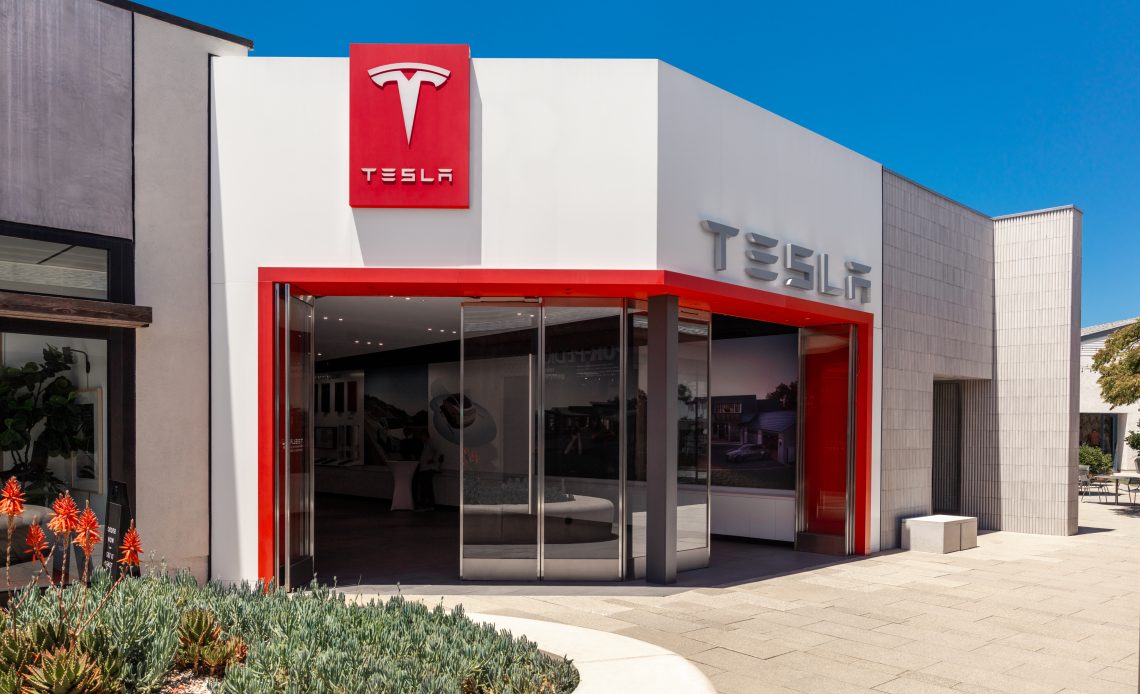
Shares of Tesla dropped more than 2% on Friday, extending recent losses as broader U.S. markets weakened amid escalating geopolitical tensions.
At the time of writing, the Tesla stock was down over 2% to trade at $372.
The Dow Jones Industrial Average fell 163 points, or 0.4%, while the S&P 500 declined 0.8%.
The Nasdaq Composite slid 1.2%, putting major indices on track for another losing week.
Investor sentiment remained fragile as Iran and Israel exchanged fresh strikes, including attacks on energy infrastructure in the Gulf.
The Pentagon is reportedly deploying additional Marines to the region, further heightening concerns about a prolonged conflict.
US President Donald Trump also escalated rhetoric around NATO, adding to geopolitical uncertainty.
Valuation disconnect comes into focus
Despite declining more than 15% this year, Tesla still commands a market valuation of roughly $1.5 trillion, making it one of the largest companies in the S&P 500.
Tesla’s latest decline reflects a convergence of pressures, including geopolitical uncertainty, regulatory risks and evolving investor expectations.
The company continues to derive most of its revenue from vehicle sales, even as those trends remain under pressure.
However, investor focus has shifted toward future growth areas such as robotaxis and humanoid robots.
UBS analyst Joseph Spak questioned the relevance of delivery numbers to Tesla’s valuation, writing that deliveries may no longer drive the stock price as they once did.
Spak projected an 18% quarter-over-quarter decline in deliveries and maintained a cautious stance, noting that enthusiasm around Tesla’s next-generation businesses may be fading.
Robotaxi concerns build
Tesla’s long-term investment case has increasingly centred on autonomous driving and robotics.
However, analysts are beginning to question whether the company can maintain a competitive edge in these areas.
Spak said there is “growing sentiment that Tesla may not sustainably differentiate on robo-taxis,” pointing to competition from Waymo and Nvidia, which are expanding their presence in autonomous driving technology.
Slower-than-expected updates on Tesla’s robotaxi and humanoid robot initiatives have also contributed to more muted investor sentiment.
Regulatory risks intensify
Adding to the pressure, US regulators have escalated scrutiny of Tesla’s driver-assistance systems.
The National Highway Traffic Safety Administration has upgraded its investigation into Tesla’s Full Self-Driving system to an engineering analysis, covering approximately 2.4 million vehicles.
The step is considered the penultimate phase before a potential recall decision.
GLJ Research analyst Gordon Johnson said the issue related to visibility detection failures may require hardware changes rather than a software update, raising the risk of more significant intervention.
He added that a forced recall could undermine Tesla’s robotaxi ambitions.
The firm has a sell rating on the Tesla stock with a price target of around $25.28.
Solar expansion plans
Separately, Tesla is exploring expansion in its energy business.
The company is reportedly planning to purchase up to $2.9 billion worth of solar manufacturing equipment from Chinese suppliers, including Suzhou Maxwell Technologies, as part of efforts to build large-scale solar capacity in the US
Chief Executive Officer Elon Musk has previously said the company aims to deploy 100 gigawatts of solar manufacturing capacity domestically by 2028.
The post Tesla stock slides 2% as regulatory risks, robotaxi doubts mount appeared first on Invezz